The loop contract
The hero artifact of this whole repo. Six fields turn "run an agent in a loop" into a governed, verifiable loop. Copy the block below, fill every field, and you have a loop worth leaving alone.
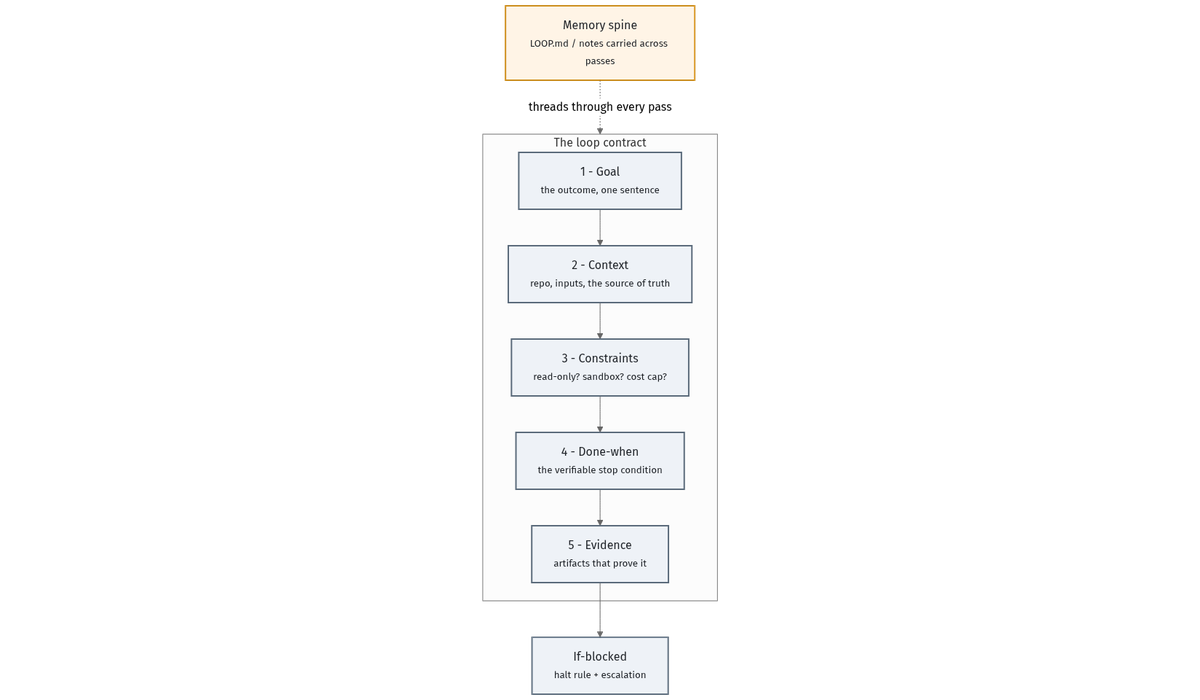
The contract
Goal:        <the outcome, in one sentence>
Context:     <repo / inputs / the source of truth the agent may use>
Constraints: <read-only? sandbox/worktree? cost cap? rate?>
Done-when:   <the single verifiable stop condition a separate checker can test>
Evidence:    <the artifacts that prove Done-when is met (logs, repro, ledger, .xlsx)>
If-blocked:  <halt rule + escalation: max no-progress passes, wall-clock cap, who to ask>
The six fields, and why each exists:
- Goal — one sentence. If it needs three, it's two loops.
- Context — names the only inputs the agent may treat as truth (this is what makes citation/reconciliation loops honest).
- Constraints — the blast-radius controls: read-only, sandbox, cost cap.
- Done-when — the verifiable condition. A separate evaluator must be able to test it (writer ≠ checker).
- Evidence — the receipts that prove Done-when. No evidence, not done.
- If-blocked — the governance escape hatch: when to halt, when to ask a human.
A "Memory spine" (a small LOOP.md) threads across passes so a fresh-context run
knows what earlier passes already did — see the
durability ladder.
This contract is canonical — the single source of truth for the six fields. The README hero ("Loop in 30 seconds") and the prompt-library cards, added in later stages, are built to reuse this exact template verbatim.
Back to the guide index · glossary