2. Two Loops, One Repo
Reconstruction for teaching. Fictional org (
Solstice/api), synthetic data; the receipts are generated, not from a real run.
Pattern: multi-loop coordination · Primitive: /loop ×2 · Domain: coding
Use when
Two independent loops need to edit the same repo (a refactor loop and a docs loop). Without coordination they overwrite each other; with a file-lease and a merge-queue they take turns.
The loop (copy-paste)
This is the library card for this example. Copy the contract and fill the brackets:
Goal:        Make <change A> and <change B> on <repo> with two loops, no conflicts.
Context:     <repo>; a lease dir (.loop-lease/) holding path-glob leases with TTL.
Constraints: Acquire a lease on your path glob before editing; heartbeat every 30s.
Done-when:   Both changes landed via the merge queue with zero conflicts/clobbers.
Evidence:    A conflicts ledger (must be 0); lease snapshots; the merge-queue order.
If-blocked:  On LOCK DENIED, BACKOFF(30s) and retry; never edit a leased path.
Verify
A separate check reads the conflicts ledger: in the coordinated phase, conflicts, clobbers, and reverts must all be zero, and every edit must map to a held lease.
Steps
- Each loop requests a lease on its path glob (TTL + heartbeat).
- On denial, back off and retry; on grant, edit then land via the merge queue.
- Record every lease grant/denial + merge to the ledger.
What happened
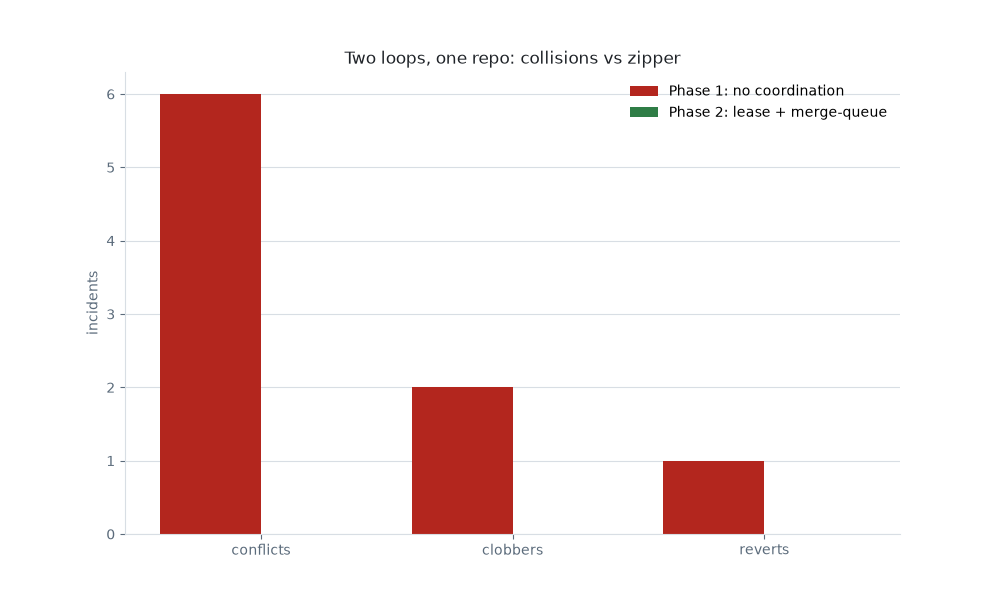
Phase 1 (no coordination): the two loops collided — 6 conflicts, 2 clobbers, and 1 revert — and burned 2.3× the tokens of Phase 2 redoing clobbered work. Phase 2 (lease + heartbeat/TTL + merge-queue): 0 conflicts. The lease turned a crash into a zipper. (Illustrative — as of June 2026, verify before relying.)
The receipts
- Conflict / coordination events — phase 1 vs phase 2.
- Lease snapshot — holder, TTL, a
BACKOFF(30s)denial. - Loop A log (refactor) · Loop B log (docs).
- Cost ledger (both phases) · all artifacts.
Notes
The coordination primitive is a lease directory + a merge-queue, not a smarter model. The LOCK DENIED / BACKOFF(30s) dance is what keeps two loops from clobbering each other.