Benefits: why loops work and where they pay
Why it works
A governed loop externalizes the four things a single long chat does badly:
-
State — each pass starts from the repo/artifacts on disk plus a small memory file (
LOOP.md), not a giant transcript. Fresh context beats context rot. -
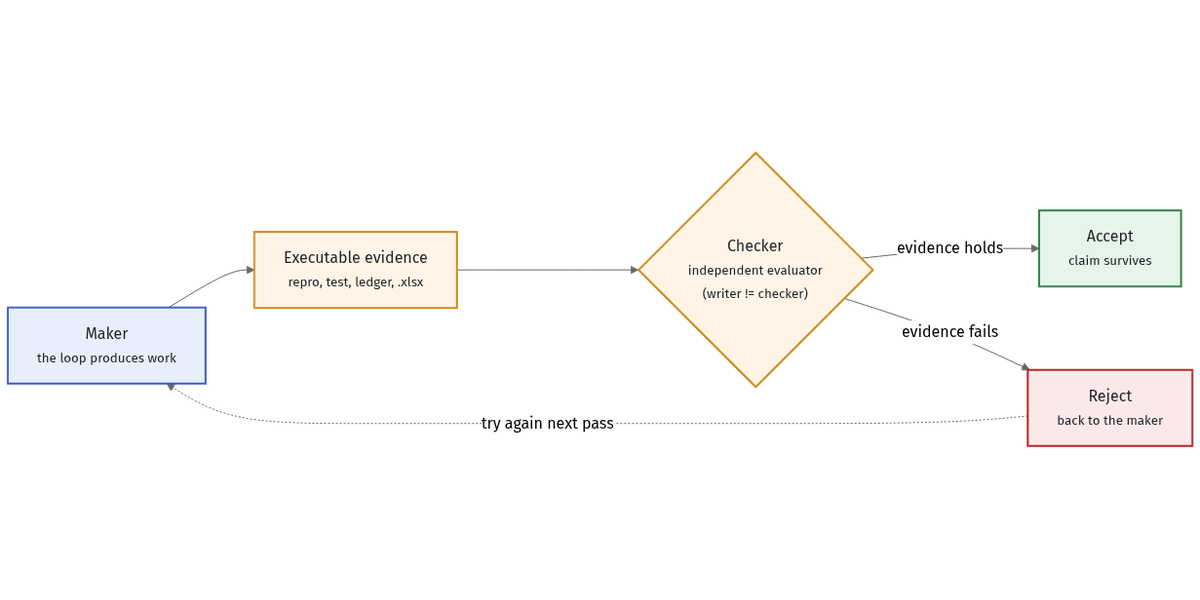
Verification — a separate evaluator checks the work, so the agent can't grade its own homework. This is the maker-checker pattern:
-
Timing — the loop decides when to run again (on change, on interval, on a failed gate) instead of you babysitting a prompt.
-
Governance — stop conditions, no-progress halts, and cost caps are first-class, so "run until done" doesn't mean "run until bankrupt."
The payoff shows up in the worked examples: the security loop
(example 3) only accepts a
finding backed by a runnable repro, and the reconciliation loop
(example 5) won't stop
until variance hits $0.00 — the gate, not the model's confidence, decides.
Where it pays
- Engineering — overnight code review, reproduce-before-you-fix, multi-loop refactors, flaky-test quarantine.
- Operations — reconciliation, spend audits, deliverability, queue patrols.
- Non-coding knowledge work — questionnaire/RFP packs that must cite a source, research that must verify a claim before keeping it.
The common thread: work with a checkable artifact at the end. If you can write the done-condition, you can engineer the loop.
Usage in practice
Self-reported, illustrative usage split for how teams spend loop time (illustrative — as of June 2026, verify before relying; see SOURCES.md): roughly 56% engineering, 17% operations, 13% non-coding knowledge work, remainder experimental. Treat these as directional, not measured.
Next: Risks and cost →